
Gold Bangle Size Guide for an Elegant Fit
A gold bangle should glide over the hand with a little resistance, then rest with quiet assurance at the wrist. Too loose, and its elegant movement can become distracting; too close, and a piece designed for effortless polish may feel difficult to wear. This gold bangle size guide makes choosing your fit more considered, whether you are selecting a slender everyday design, a sculptural statement piece or a meaningful gift.
Unlike a clasp bracelet, a traditional closed bangle must pass over the widest part of the hand. That simple distinction is why wrist measurement alone rarely tells the full story. The right size is a balance of hand circumference, bangle shape, metal weight and the way you prefer your jewellery to sit.
Gold Bangle Size Guide: Start With Your Hand
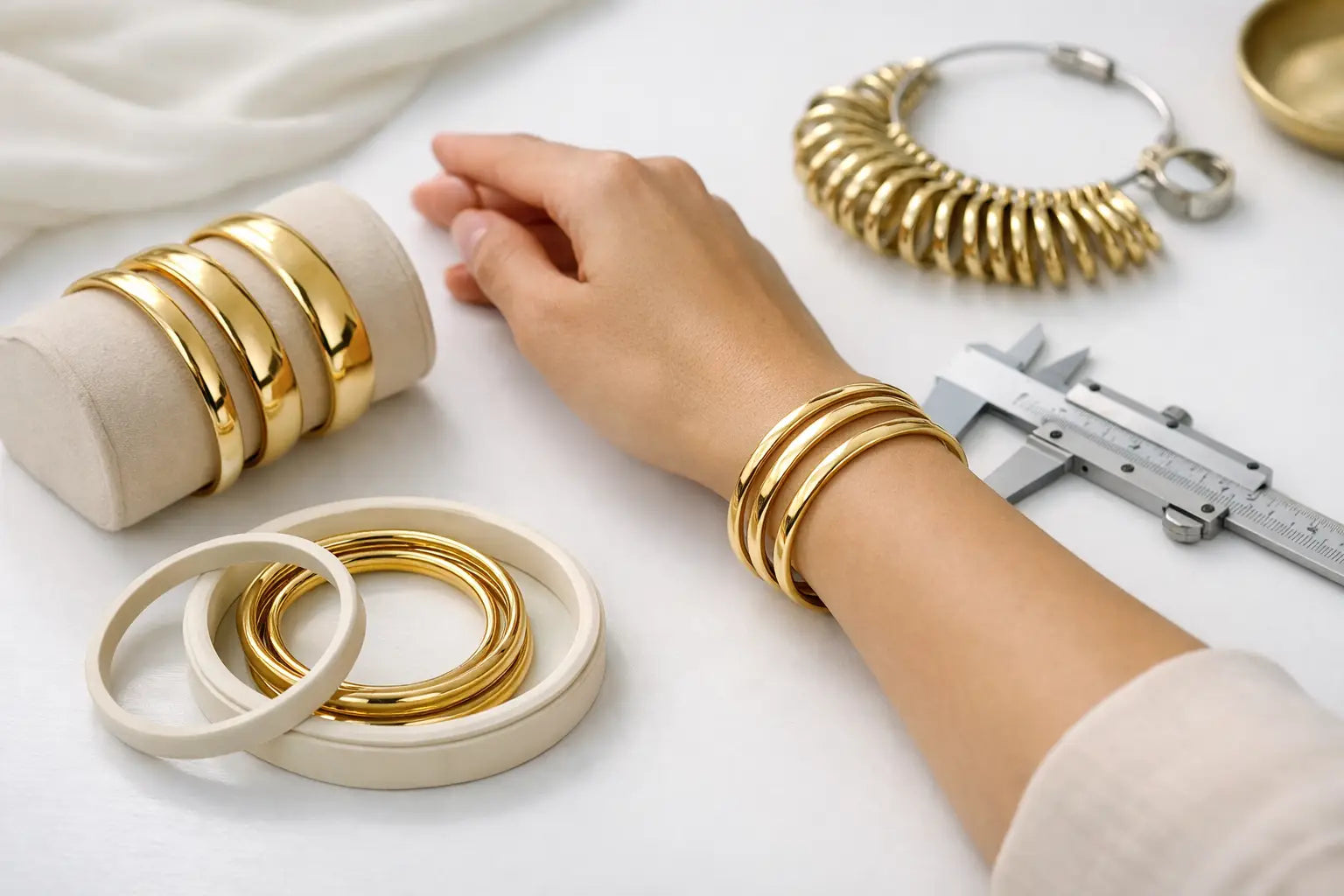
The most reliable at-home method is to measure the hand in the position it naturally takes when slipping on a bangle. Bring your thumb and little finger together, as though your hand is narrowing to pass through a circular opening. Do not clench tightly. A relaxed pose gives a more realistic measurement and leaves enough room for comfort.
Wrap a flexible tape measure around the widest part of the knuckles and palm. Keep it firm against the skin without pulling it tight. Record the circumference in millimetres. If you do not have a tape measure, use a narrow strip of paper or ribbon, mark where it meets, then measure that length against a ruler.
This is your starting point, not an instruction to choose a bangle with the same circumference. A closed bangle needs a small allowance to move over the hand and settle naturally at the wrist. If your measurement falls between two sizes, the better choice depends on the design and your preferred feel. For a substantial solid-gold bangle, or a wide profile with little flexibility, selecting the larger option is usually the wiser decision. For a fine, slim bangle intended to sit close to the wrist, the smaller of the two may offer the more refined result.
Convert hand circumference to inner diameter
Bangle sizes are often shown by their inner diameter. To convert your hand circumference, divide it by 3.14. For example, a hand measurement of 200 mm converts to an approximate 63.7 mm internal diameter. In practice, this suggests trying a bangle close to 64 mm inside diameter, subject to the profile and shape of the piece.
A useful guide is as follows:
- A hand circumference of around 175 mm generally corresponds to an inner diameter of approximately 56 mm.
- Around 185 mm corresponds to approximately 59 mm.
- Around 195 mm corresponds to approximately 62 mm.
- Around 205 mm corresponds to approximately 65 mm.
- Around 215 mm corresponds to approximately 68 mm.
Use a Bangle You Already Love
If you own a closed bangle that feels exactly right, it offers the clearest reference. Place it flat on a level surface and measure straight across the inside from one edge to the other. This is the internal diameter. Avoid measuring the outer edge, as the thickness of the gold can add several millimetres and lead to an unnecessarily large new piece.
For oval bangles, measure both the shorter and longer internal widths. The shorter measurement is especially helpful because it relates to how the bangle sits across the wrist, while the longer measurement shows the room available for the hand to pass through. Compare both figures with the dimensions provided for the piece you are considering.
This approach is particularly valuable when choosing a bangle as a gift. Measuring a bangle already worn by the recipient preserves the surprise while providing a much more dependable indication than estimating from wrist size or clothing size.
Round, Oval and Hinged Designs Fit Differently
A round bangle has a classic, symmetrical presence and moves freely around the wrist. Because it must travel evenly over the widest part of the hand, it may need a little more room than an oval version. It is a beautiful choice for stacking, especially when mixing polished gold with diamond-set or textured finishes, but the size should leave enough space for several pieces to sit together without feeling restrictive.
An oval bangle follows the natural contour of the wrist more closely. It can feel secure and tailored while retaining the clean line of a traditional bangle. Many people find an oval shape easier to wear daily, particularly if they prefer a bangle that does not rotate as much as a round one. Still, the hand must comfortably pass through the opening, so do not size down simply because the finished look is neater.
A hinged bangle removes much of the challenge. Its opening allows it to be placed around the wrist rather than pushed over the hand, making wrist circumference the key measurement. It should close securely without pinching and should not spin excessively. This style is often an excellent choice for someone with prominent knuckles, a smaller wrist relative to their hand, or a preference for a close-fitting jewel.
Cuff bangles are different again. Their open gap offers some flexibility, but it should not be repeatedly pulled wide or squeezed narrow. Gold is precious and resilient, yet continual bending can affect the shape and tension of a finely crafted piece over time. Choose a cuff that slips on with gentle pressure and retains its intended curve.
Consider Width, Weight and Your Styling Preference
The dimensions of a bangle influence fit as much as its diameter. A wide bangle covers more of the hand as it passes over the knuckles, so it often requires extra clearance. A weighty 18ct gold piece may feel more present than a slender 9ct design of the same size, simply because its movement is more noticeable. Neither is better - it comes down to how you want the jewellery to perform in your day.
For a clean, close-to-the-wrist effect, choose a size that passes over your hand without force and leaves only a modest amount of movement once on. This creates a composed, architectural look that works beautifully with tailoring, eveningwear and a single standout bangle.
For relaxed daily styling or a layered wrist, a slightly roomier fit has its advantages. It allows bangles to shift gracefully alongside a watch, chain bracelet or contrasting metal pieces. The trade-off is more movement and occasional contact between designs. If you are combining diamond-set bangles with other jewellery, consider spacing, setting style and wear patterns so each piece retains its finish.
How a Gold Bangle Should Feel
A correctly sized closed bangle should pass over the hand with controlled ease. It should not require soap, force or repeated twisting to put on, and it should not slip off when your hand is relaxed at your side. Once at the wrist, it may move, but it should not feel as though it is constantly travelling towards the hand.
Try your bangle during the moments that matter: typing, reaching for a bag, holding a glass and putting on a coat. Fine jewellery should complement your rhythm, not ask you to adjust your movements around it. If you are choosing for an occasion, remember that a piece worn for an evening may suit a closer, more sculpted fit than one intended to become part of your everyday signature.
When to Ask for Personal Guidance
Measurements are especially useful, but they cannot always account for individual hand shape, knuckle prominence or the particular construction of a design. If you are between sizes, selecting a high-value gift, or commissioning a bespoke bangle, personal guidance is worthwhile. A jewellery concierge can help interpret measurements against the profile, hinge mechanism and intended styling of the finished piece.
For bespoke work, proportion can be refined beyond size alone: the ovality of the form, the depth of the gold, a hidden clasp, an engraving placement or the balance of diamonds along the curve. Harper Kendall approaches these details as part of the art of beautiful design, ensuring a bangle feels as individual as the person who wears it.
The finest fit is not the tightest or the loosest. It is the one you stop noticing because it has become entirely your own - a considered line of gold that moves with you, catches the light and belongs effortlessly to your collection.