




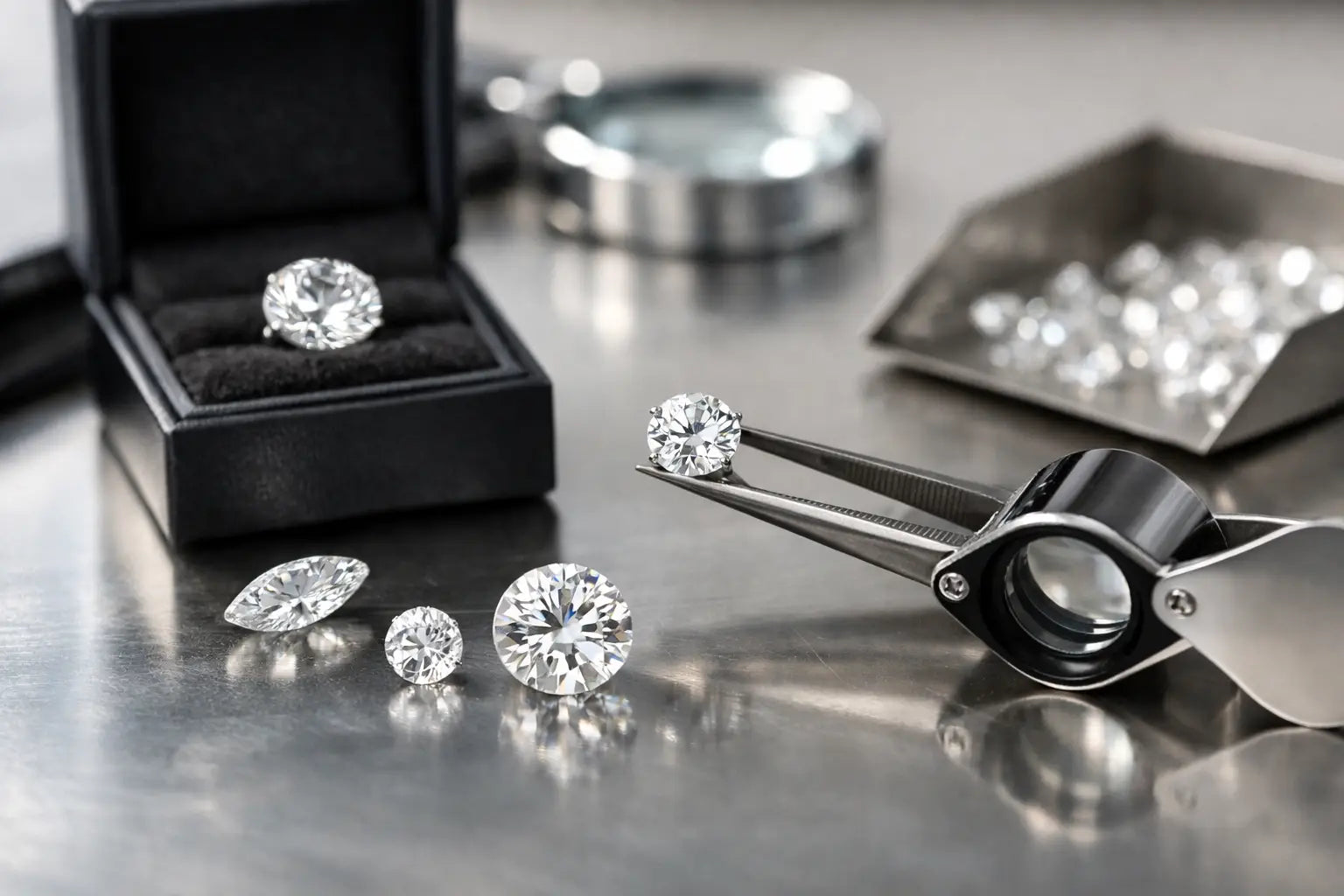
How to Choose Diamond Clarity With Confidence
A diamond can look beautifully clean to the eye without being flawless under a jeweller’s magnification. That distinction is the key to understanding how to choose diamond clarity with confidence. Rather than pursuing a technical grade in isolation, choose a stone whose clarity complements its cut, proportions, setting and the way you want to wear it.
For an engagement ring, a fine pendant or a pair of diamond earrings, the most considered choice is usually the one that delivers exceptional light, character and confidence when viewed in real life. Clarity is part of that story, but it is never the whole design.
What diamond clarity really measures
Diamond clarity describes the tiny internal features, known as inclusions, and surface characteristics, known as blemishes, visible within a diamond. These natural details were created as the diamond formed deep within the earth. In a laboratory-grown diamond, they arise during the growth process instead.
A clarity grade reflects the number, size, position, colour and visibility of these characteristics when the stone is examined at 10x magnification. The scale runs from Flawless to Included, with several grades in between:
- Flawless (FL) and Internally Flawless (IF) diamonds have no inclusions visible at 10x magnification, or only minute surface features in the case of IF.
- Very, Very Slightly Included (VVS1 and VVS2) diamonds contain extremely difficult-to-see inclusions.
- Very Slightly Included (VS1 and VS2) diamonds have minor inclusions that are usually difficult to identify under magnification.
- Slightly Included (SI1 and SI2) diamonds have noticeable inclusions under magnification, although some can still appear clean to the unaided eye.
- Included (I1, I2 and I3) diamonds have inclusions that may be visible without magnification and can sometimes affect durability or brilliance.
How to choose diamond clarity for the way you wear it
The most useful phrase in diamond clarity is “eye-clean”. This means inclusions are not readily visible to the naked eye in normal viewing conditions. For many buyers, an eye-clean diamond is the ideal balance of visual purity and considered selection.
A ring sits close to the eye and is often inspected in detail, so clarity can matter more for a large centre stone than it does for smaller accent diamonds. Even so, a carefully chosen VS2 or SI1 diamond can be strikingly clean, especially when its inclusions are small, pale and positioned discreetly.
For diamond earrings, tennis bracelets and pavé-set designs, individual diamonds are generally smaller and viewed as part of a glittering composition. In these pieces, the overall harmony of the stones, the precision of the setting and the quality of the light return often have a greater visual effect than a very high clarity grade.
A solitaire pendant occupies a middle ground. It is visible, personal and often worn every day, but it is not studied as closely as a ring. An eye-clean diamond with lively sparkle can be a wonderfully elegant choice.
Consider diamond size before moving up the clarity scale
As a diamond becomes larger, its inclusions may become easier to see. This does not mean a larger diamond always needs a high clarity grade. It means the individual stone deserves closer consideration.
With a smaller diamond, a VS or SI clarity may appear entirely pristine in wear. With a larger centre stone, it can be sensible to look for a grade where inclusions are less prominent, particularly if they are positioned beneath the table - the broad, flat facet at the centre of the diamond. Inclusions near the edge may be less noticeable and can sometimes be concealed by a claw setting, depending on their nature and location.
The grade on a certificate is a starting point. The personality of the individual diamond is what completes the picture.
Clarity, cut and sparkle: the balance that matters
When choosing a diamond, cut is often the feature that most strongly influences its brilliance. A beautifully cut diamond returns light with crisp, animated sparkle, while a poorly proportioned stone can appear less lively even at a very high clarity grade.
This is why clarity should be chosen alongside cut rather than ahead of it. A diamond with excellent proportions, pleasing symmetry and strong light performance can look more luminous than a technically purer stone with less captivating cut quality.
Colour also plays a role. In a bright white metal setting, some clients prefer a colourless-looking diamond, while yellow or rose gold can create a flattering, warmer contrast. Clarity remains a separate grade, but all of the diamond’s characteristics work together in the finished design. The most harmonious stone is rarely chosen by one specification alone.
Diamond shape changes what you can see
Different diamond shapes reveal inclusions in different ways. Round brilliant diamonds are particularly forgiving because their facet pattern creates abundant sparkle, helping to disguise small internal characteristics. This makes them a popular choice for those seeking an eye-clean appearance without selecting at the highest end of the clarity scale.
Step-cut shapes such as emerald and Asscher cuts have broad, open facets and a calm, hall-of-mirrors effect. Their clarity tends to be easier to assess because there is less scintillation to conceal inclusions. For these elegant, architectural shapes, many people choose a higher clarity range, especially for a larger centre stone.
Oval, pear and marquise diamonds can be lively and flattering, though each should be viewed individually. Their elongated forms may draw the eye across the stone, and the location of an inclusion matters as much as the grade itself. Radiant, cushion and princess cuts offer more facet activity, often making minor inclusions less apparent in everyday wear.
Look beyond the clarity grade on paper
Two diamonds with the same clarity grade can look noticeably different. A clarity grade represents a considered assessment, but it covers a range of possible inclusion patterns. One VS2 diamond may have a tiny crystal close to its girdle, while another may have a more central feather. Both can receive the same grade, yet one may be more visually appealing for your chosen design.
When assessing a stone, consider where the inclusion sits, whether it is dark or colourless, and whether it affects the diamond’s transparency. A small inclusion close to the edge can be less visible than one placed directly beneath the table. A scattered pattern of minute inclusions may also be less apparent than one distinct feature.
Certain inclusions deserve particular professional attention. Feathers, which are internal breaks, and inclusions that reach the surface can be relevant if they are extensive or located in a vulnerable area, such as the point of a pear, marquise or princess-cut diamond. This is not a reason to dismiss every diamond with these characteristics. It is a reason to select with expert guidance and ensure the setting protects the stone appropriately.
Choose clarity with the setting in mind
A setting is not simply a frame for a diamond. It is part of how the stone will be seen. Claw-set solitaires leave more of the diamond exposed, making the centre stone the focus from every angle. Halo designs, pavé shoulders and three-stone rings introduce additional light and detail, which can make modest inclusions in the centre diamond less noticeable.
Bezel settings offer a clean, contemporary outline and can provide welcome protection around the diamond’s edge. They may also conceal an inclusion positioned near the girdle. For a bespoke piece, this is where design becomes especially valuable: the setting can be tailored to enhance the diamond’s strongest qualities rather than asking the diamond to conform to a fixed design.
Metal choice can subtly influence perception too. Platinum and white gold create a crisp, modern backdrop, while yellow gold and rose gold lend warmth and distinction. There is no universal rule here. The right choice is the one that reflects your style and makes the diamond feel unmistakably yours.
Trust the certificate, then trust your eye
A diamond grading report from an independent laboratory provides an objective record of the stone’s clarity, alongside its cut, colour, carat weight and measurements. It is an essential part of informed diamond selection, particularly for a significant centre stone.
Yet certification cannot replace viewing the diamond. Examine it in varied light where possible: soft daylight, direct light and the gentler light of an interior setting each reveal a different aspect of its character. Ask whether the inclusion is visible without magnification, whether it distracts from the stone’s brilliance and whether you would notice it after the diamond is set.
For a personal commission, a jewellery concierge or bespoke designer can help interpret the technical details in relation to the finished piece. This is particularly reassuring when comparing diamonds of similar grades, selecting an unusual shape or designing around a meaningful stone.
A more personal standard of perfection
Perfection in a diamond is not only a laboratory definition. It is the moment a stone catches the light on your hand, rests at the collarbone or becomes part of a piece you reach for every day. Choose clarity thoughtfully, favour an eye-clean appearance where appropriate, and let exceptional cut and considered design carry the brilliance. The most memorable diamond is the one that feels beautifully resolved in your life, not merely on a grading chart.